

Original Source: CTPost
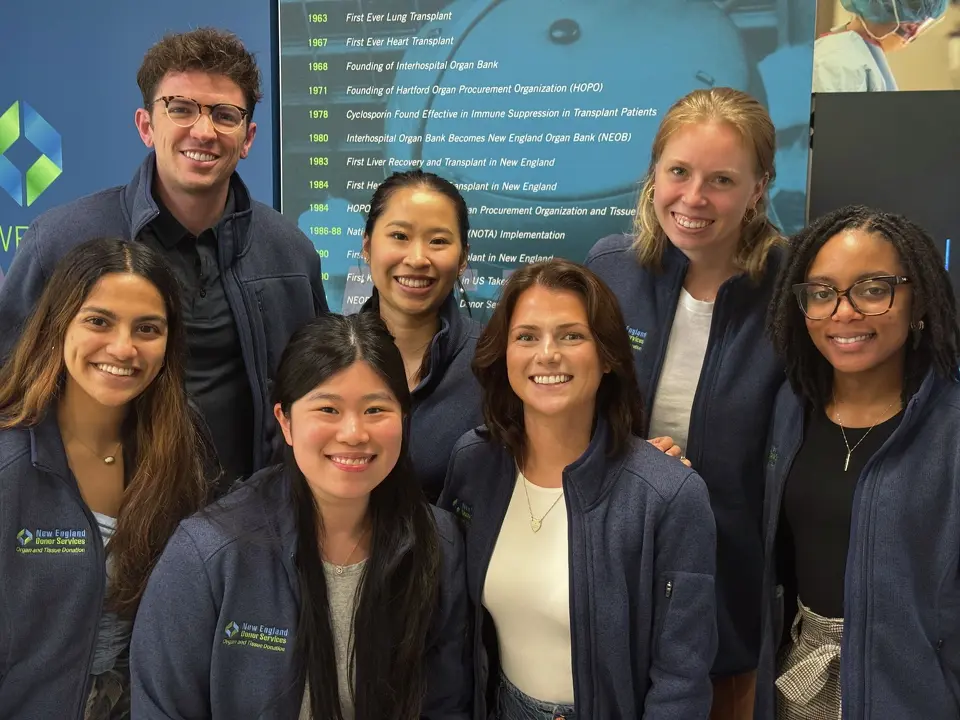
Photo: Contributed by NEDS
Most students spend their summer vacations visiting the beach or riding their bikes through town, but not Riley Cable and Lila Medeiros.
The pair of rising second-year University of Connecticut medical school students instead spent a portion of their summer break at an eight-week intensive program learning about organ transplants, the various roles in the field and racial inequities some communities faced.
Called the Galen V. Henderson, MD Stimulate Equity, Education, and Diversity, or SEED program, was hosted by New England Donor Services, the federally designated organ procurement organization for the area, at their Waltham, Massachusetts office, just outside of Boston.
Education around organ transplantation varies and is typically available to medical students later in their education after picking a specialization, said Dr. Jim Rodrigue, director of data research and insights at NEDS. At the same time, the transplantation field is seeing a workforce shortage.
Rodrigue, who is the director for the SEED program, said the idea behind creating a specialized, intensive course was to expose medical students early in their schooling to the transplant field and the various roles while also increasing awareness about inequities in donation and transplants.
For example, donor registration rates among Black, Asian and Hispanic Americans are lower compared to other racial and ethnic groups, according to a study by the National Research Council. Black patients are also less likely than white ones to be preemptively referred for transplant evaluation.
The eight-week program was divided into several lectures, visits and conversations, including shadowing in the operating room during transplants, connecting with experts in the field and talking with families impacted by organ donation. It is named in honor of the late Dr. Galen V. Henderson, who was an associate medical director of NEDS and died in 2023.
Rodrigue said the programming and curriculum were heavily inspired by an initiative started at historically Black universities and colleges in collaboration with the Association for Organ Procurement Organizations that looked to increase awareness around disparities and inequities.
“We’re trying to do something that potentially could impact the workforce going forward,” he said. “Even if the students decide to go in a field or a specialty outside of transplantation, we feel that this program has been invaluable for them because the nature of their understanding of organ donation and end-stage organ disease will pay dividends in their interactions with patients downstream.”
The inaugural session, which ran from June to July, hosted seven students from across New England’s medical schools — from Harvard to the University of Vermont.
Both Cable and Medeiros said they learned about the program after receiving an email from UConn with a link to apply.
Cable, who entered the program with an interest in surgery, left with a sharper focus after discovering just how widespread organ donation and transplants are. Procedures such as skin grafts or muscle tissue transplants often rely on donations from deceased patients — a fact that, for him, underscored both the profound humanity and the critical role of transplantation in modern health care.
He added that to him, it was like watching “the social determinants of health unfold in real time” as he spoke with families and heard their struggles with barriers to care, including transportation.
“It seems like transplant encompasses all of the social determinants of health, because there’s so much to it,” Cable said. “It’s such a multi-disciplinary part of health care … There’s so many factors that go into being able to even just get listed for a transplant.”
Medeiros echoed Cable’s enthusiasm for the program, but said her favorite part was specifically connecting with the families. She said those conversations involved people who received organs or families who decided to donate their loved one’s organs.
Seeing both sides of the experience, Medeiros said, is “one of the most beautiful and unique things about organ transplantation, you don’t get in a lot of other specialties. It is making light of that darkness and people still being so selfless in that heartbreak.”
She said these conversations helped the group step away from the science and focus on their ultimate goal — helping people.
“I will not forget their stories and just try to keep them in mind with whatever, whoever I’m talking to, patient or person,” said Medeiros, who has her eyes set on being a surgeon. “You just don’t know what someone has in their past and what incredible things they’ve been through.”